
Different Types of Plaster & Their Uses
From browning plaster to thistle plaster and one-coat plaster, there are many different types of plaster used across the UK, each of them with its own advantages and disadvantages. If you are planning a house renovation project but you are not a plastering expert, read along to find out more about the 8 most popular plaster varieties and their unique properties.
What is Plaster?
Before we dive into the details, let’s start with the basics first. Plaster serves as a versatile construction material employed to finish walls and ceilings, providing a protective layer that can be painted. Typically composed of a blend of gypsum powder and water, it is applied to walls and ceilings in a uniform, smooth layer.
Plaster has been used in construction all over the world for centuries, starting with the Ancient Egyptians. Essentially, it is a type of coating that you can use to cover internal walls and ceilings for protection against the elements or simply for decorative purposes. The mixture used for exterior walls is usually referred to as render.
Plaster is typically applied in two coats – a base coat (undercoat) and a skim coat (topcoat). The base coat serves to even out the wall and remove any holes and cracks. The skim coat creates a beautiful smooth finish for an aesthetically pleasing look.
What Type of Plaster is Used for Walls?
When it comes to plastering walls, browning plaster and bonding plaster are viable undercoat options for building additional layers. Both are an excellent selection for walls and various structural elements, suitable for use in both new constructions and existing homes.
Common Types of Plaster
Now that we know the basic terminology, let’s explore the various types of plaster used in construction to find out what works best for your construction project.
Browning Plaster

Browning plaster is a popular solution for creating a solid, even undercoat. It’s a great choice for applying on top of brickwork and other absorbent surfaces. The thickness you’d want to achieve is about 11mm for walls and 8mm for ceilings. Usually, browning plaster will dry in a couple of hours but as a rule of thumb, you should leave the application of skimming plaster until at least 24- 48 hours.
Best for: Base coat
Average price: £0.30 to £0.60 per kg
Bonding Plaster
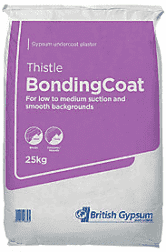
Bonding plaster is the more versatile brother of browning plaster. It’s an undercoat type of plaster that can be used on pretty much any surface, regardless of the absorption levels, which makes it very popular. Except that, it has the same drying time and thickness requirements as browning plaster. If your wall or ceiling is already relatively smooth, you could use bonding plaster as a finishing coat too.
Best for: Base coat
Average price: £0.40 to £0.50 per kg
Hardwall Plaster
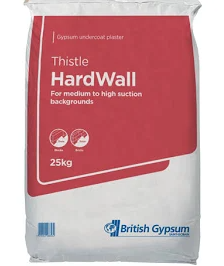
Continuing with the undercoat plaster varieties, here comes hardwall plaster. Extremely durable, easy to apply and boasting fast drying times of just 1-2 hours, it’s a popular option, especially for areas with heavy foot traffic. Hardwall plaster is the best match for masonry walls, be it brick, cement blocks, stones or marble. Bear in mind that if the wall underneath isn’t very stable, it may cause the plaster to crack.
Best for: Base coat
Average price: £0.40 to £0.50 per kg
Tough Coat Plaster
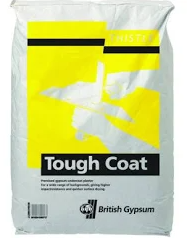
Tough coat plaster is the most durable of all undercoat plasters. It has high impact, weather and fire resistance, which means it can handle a lot more than other types of plaster. It’s also perfect for masonry walls. The one downside of tough coat plaster is that it doesn’t do well with prolonged exposure to moisture. Moisture can weaken it over time, causing adhesion problems and the appearance of damp spots.
Best for: Base coat
Average price: £0.35 to £0.50 per kg
Thistle Plaster

Thistle plaster is best suited for a finish coat and it is one of the most versatile and easy-to-use plasters. This makes it a perfect solution for small repair jobs. Homeowners love it because it offers a smooth finish that leaves their walls ready for decoration, while plasterers prefer thistle plaster because it can be used in combination with plasterboard and because it can be applied either by hand or by using tools depending on their preferences. It doesn’t take long to dry either – just 1.5 hours!
Best for: Skim coat
Average price: £0.29 to £0.64 per kg
Carlite Plaster

Carlite plaster is another well-known skim-coat plaster. It’s quite durable and versatile in terms of decorative finishes. However, it takes about 3 hours to dry which is twice as long as the time it takes for the thistle to dry. That being said, carlite plaster is scratch and impact-resistant, so it’s a good option too if you are after a long-lasting product and don’t mind the waiting time.
Best for: Skim coat
Average price: £0.46 to £1.00 per kg
One Coat Plaster

Most plasters are good for either an undercoat or a finish but one coat of plaster, as the name suggests, can be used for both. Made with gypsum, it creates one thick layer (about 25mm) which is sufficient on its own and since it’s scratch-resistant too, it doesn’t require a protective skim coat. One coat plaster is also versatile in terms of application method, as it can be done by hand or by using mechanical tools, which makes it an industry favourite for small-area repairs.
Best for: Both
Average price: £0.61 to £0.83 per kg
Dri-Coat Plaster
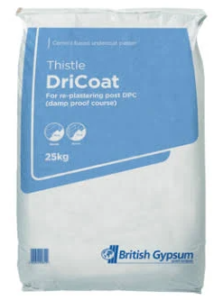
As an honourable mention on our list, we decided to include dri-coat plaster. It offers a handy solution when you have damp-related problems. It blocks out the hygroscopic salts which are responsible for moisture getting trapped in your walls. It’s worth noting that dri-coat plaster doesn’t perform well under extreme temperatures, so it’s not optimal in freezing conditions and if you want to ensure strong fire safety in the building you’ll have to look into additional fire protection.
Best for: Re-plastering and damp protection
Average price: £0.85 to £1.44 per kg
Hardwall Plaster vs. Bonding Plaster
Hardwall plaster is best suited for extensive surfaces and substantial indentations, whereas bonding plaster is ideal for applying a thin layer on uneven substrates before final skimming. For example, when faced with a situation where tiles have been removed and the wall surface is not conducive for direct skimming, a smooth coat of bonding plaster serves as a preparatory layer. Notably, bonding plaster adheres well to plasterboard, a characteristic that sets it apart from hardwall plaster.
A Plaster Undercoat
A plaster undercoat refers to the initial layer of plaster applied to a surface, often as part of the process of creating a smooth and even finish on walls or ceilings. This undercoat is also known as a base coat or scratch coat. The purpose of the plaster undercoat is to provide a solid foundation for subsequent layers of plaster and to create a surface that is suitable for finishing.
The process typically involves applying a mixture of plaster, sand, and sometimes other additives to the substrate, such as lath or masonry. This base coat is then levelled and allowed to set before additional layers of plaster, including the final finishing coat, are applied. The undercoat helps to create a strong and stable surface, covering irregularities in the substrate and ensuring a more uniform finish in the final plastered surface.
Plastering is a traditional technique used in construction and interior finishing to achieve smooth, durable, and aesthetically pleasing surfaces on walls and ceilings.
A Plaster Topcoat
A plaster topcoat, also known as a finish coat or skim coat, is the final layer of plaster applied to a surface after the undercoat or base coat has been set. This topcoat serves several purposes in the plastering process:
- Smooth Finish: The topcoat is designed to create a smooth and even surface on walls or ceilings. It helps to eliminate any imperfections, irregularities, or roughness left by the undercoat.
- Appearance: The finish coat contributes significantly to the aesthetic appearance of the plastered surface. It is the visible layer that people see, and its texture and colour can be customised based on the desired look.
- Durability: While the undercoat provides structural support, the topcoat enhances the durability and resistance of the plastered surface to wear and tear. It adds a protective layer that helps maintain the integrity of the plastered area.
- Sealing: The finish coat also serves as a sealant, helping to protect the underlying layers from moisture and other environmental factors. This is crucial for maintaining the longevity of the plastered surface.
The topcoat is typically thinner than the undercoat and is applied with precision to achieve a polished and refined appearance. It may consist of a mixture of plaster and other materials, such as lime or gypsum, depending on the specific requirements and preferences. Skilled plasterers often use various techniques to achieve different textures or patterns in the finish coat, providing a decorative element to the final surface.
| Type of Plaster | Use | Best For |
| Browning Plaster | Undercoat | For walls and various structural elements, suitable for use in both new and existing homes. |
| Bonding Plaster | Undercoat | For applying a thin layer on uneven substrates before final skimming; notably adheres well to plasterboard. |
| Hardwall Plaster | Undercoat | Best suited for extensive surfaces and substantial indentations, such as masonry, bricks and concrete |
| Gypsum Plaster | Finishing | One of the three main varieties; generally recommended for interior walls due to its versatility and ease of use; ideal for wall applications as it provides a smooth finish. |
| Lime Plaster | Undercoat and Finishing | One of the three main varieties; renowned for its durability and longevity; often considered the most effective for its breathability and compatibility with historic structures. |
| Cement Plaster | Undercoat | One of the three main varieties; the most robust plaster for walls; suitable for robust wall construction, providing strength and durability. |
Breathable Insulating Plaster
As UK retrofit guidance, such as PAS 2035:2023, increasingly emphasises whole-house, moisture-risk-aware upgrades, breathable insulating plasters have emerged as a vital solution for modernising older properties. These products often function as Thin Internal Wall Insulation (TIWI) and are particularly advantageous for older buildings constructed with solid brick or stone walls.
Historically, solid walls were designed to manage moisture naturally by absorbing and releasing water. Applying impermeable plaster materials to these structures can trap water vapour, leading to pockets of condensation, mould, and eventual structural degradation. Breathable insulating plasters typically combine a lime or clay binder with naturally aerated aggregates like cork, hemp shiv, or perlite. These materials allow trapped moisture to diffuse outward safely, because they have capillaries that draw the moisture through the plaster, preserving the building’s traditional moisture dynamics.
Beyond moisture management, these plasters have a profound impact on home heating and energy efficiency. Standard plaster offers minimal thermal resistance, typically presenting a thermal conductivity (k-value) of around 0.50 W/mK. In contrast, insulating plasters can achieve highly efficient k-values between 0.037 and 0.127 W/mK. Applying these plasters increases the internal wall surface temperature, which:
- minimises cold bridging
- improves occupant thermal comfort
- significantly reduces overall heating costs.
Government-backed field trials indicate that retrofitting solid walls with TIWI can reduce whole-house heat loss by 10% to 17%, allowing homeowners to cut down on their space heating bills without the drastic spatial reduction required by thick insulation boards.
Current retrofit advice strongly cautions against the unintended consequences of using conventional, non-breathable Internal Wall Insulation (IWI) boards on older properties. Hygrothermal simulations and laboratory tests reveal that conventional IWI can trap moisture and substantially increase the risk of rot in embedded timber joists within solid walls. Breathable TIWI systems, however, pose a significantly lower risk of moisture accumulation in the inner brick leaf. By effectively balancing crucial thermal upgrades with the breathability required by older solid walls, insulating plasters provide a safer, less disruptive, and highly effective retrofit strategy.
Is it Worth Hiring a Professional Plasterer?
If you like your DIY, you could plaster a wall by yourself but there are a few pitfalls to avoid. From mixing the mixture incorrectly to getting the plaster drying time wrong and applying it unevenly, a lot can go wrong if you don’t have enough experience working with plaster. If things don’t go according to plan, you could end up with a few problems on your hand, including cracks, damp and mould.
If you want to avoid the headache, hiring a professional plasterer to do the job is a good idea. How much plastering costs depends on the size of the project and the type of plaster used, so it’s useful to collect a few quotes before choosing a plasterer
Need a plasterer in the South West? Give AB Drylining a call on 01225 941006 or 07983879762 and get a quick quote today. We work with all types of plaster, so give us a ring and we can discuss your options!
FAQ
Which plaster type is recommended for optimal results?
For optimal results, a gypsum plaster with good bonding properties is recommended.
What type of plastering yields the best outcome?
A professionally executed traditional plastering technique often yields the best outcome.
Which plaster is known for its durability?
Lime plaster is renowned for its durability and longevity.
What is the top choice for a multi-finish plaster?
A high-quality multi-finish plaster, such as a gypsum-based option, is a top choice for versatile applications.
Which plaster type is ideal for wall applications?
Gypsum plaster, known for its smooth finish and ease of application, is ideal for wall surfaces.
What is the recommended plaster for interior walls?
The recommended plaster for interior walls is typically gypsum-based due to its versatility and ease of use.
Which plaster is suitable for wall construction?
Cement plaster is suitable for robust wall construction, providing strength and durability.
What are the three varieties of plaster?
Plaster comes in three main varieties: gypsum, lime, and cement.
Do various kinds of plaster exist for walls?
Yes, various kinds of plaster exist for walls, including gypsum, lime, and cement-based options.
Which wall plaster is considered the most effective?
The plaster you should use will vary depending on where you want to plaster. For example, lime plaster is often considered the most effective for its breathability and compatibility with historic structures.
What is the most robust plaster for walls?
The most robust plaster for walls is cement plaster, known for its strength and durability.
How does plastering differ from skimming?
Plastering involves applying a base coat to a surface while skimming is a finishing technique that creates a smooth, even surface over the plastered area.